
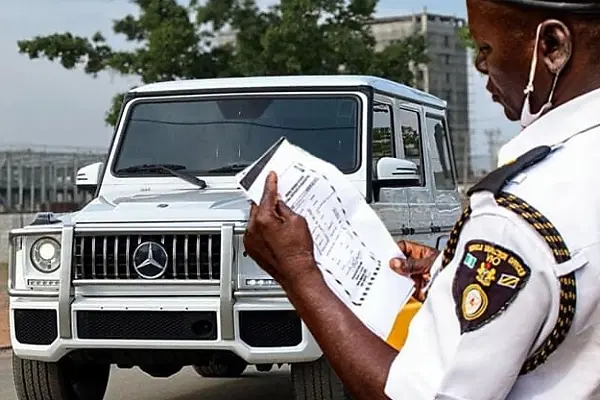
The Lagos State Government has clarified that the recent judgment by a Federal High Court in Abuja, which bars the Vehicle Inspection Office (VIO) from stopping and impounding vehicles, does not extend to Lagos. This assurance was given by the Lagos State Commissioner for Transportation, Mr. Oluwaseun Osiyemi, in a statement released on Tuesday.
According to Osiyemi, the court’s ruling, delivered by Justice Evelyn Maha, only applies within the Federal Capital Territory (FCT), Abuja. He emphasized that in legal practice, courts have territorial limits to their jurisdiction, and in this case, the decision does not affect Lagos State’s enforcement of its own traffic regulations.
The court case, registered as FHC/ABJ/CS/1695/2023, was a fundamental rights enforcement suit filed in Abuja, challenging the authority of the VIO in the FCT to stop, impound, or impose fines on motorists. Justice Maha ruled that there was no law in place within Abuja that granted the VIO such powers.
However, Osiyemi pointed out that Lagos State operates under its own legal framework—the Transport Sector Reform Law of Lagos State (TSRL-2018). This law, particularly Part II, Sections 11-22, clearly establishes the duties and powers of the VIO in the state. Under this legislation, VIO officers are authorized to enforce traffic laws, stop vehicles, and impose penalties for violations, which are detailed in a schedule listing 52 specific infractions.
Osiyemi reassured motorists in Lagos that the operations of the VIO remain fully lawful and unaffected by the Abuja ruling. He advised drivers to continue abiding by Lagos traffic laws and cooperating with the VIO to ensure safety on the roads.
“The Federal High Court’s decision is specific to the VIO in Abuja and has no bearing on Lagos. Here, the VIO operates under our established Transport Sector Reform Law, which gives them the authority to manage and enforce traffic regulations,” the commissioner stated.
In conclusion, Osiyemi urged motorists in Lagos to remain law-abiding and respect the local traffic enforcement system, assuring them that the state’s laws would continue to be enforced in accordance with the TSRL-2018.