
By Ding Yiting, People’s Daily
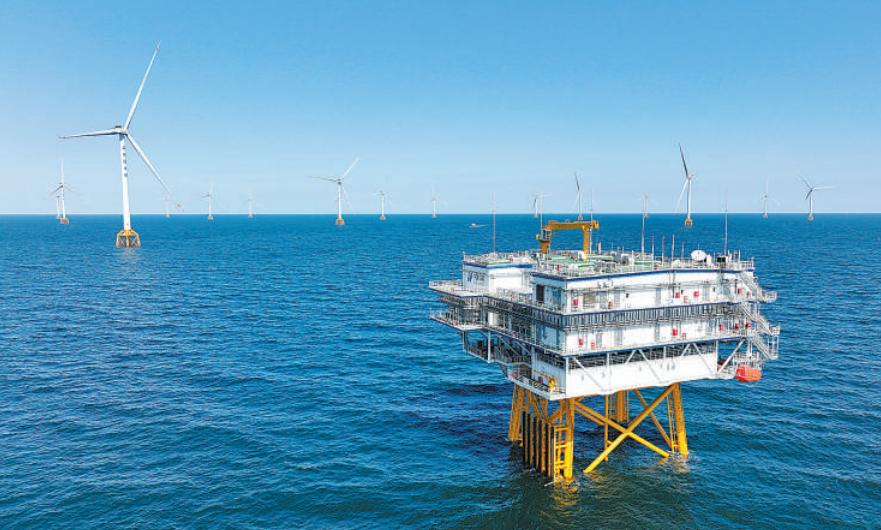
China has achieved a new breakthrough in offshore wind power, as the country’s deepest offshore wind project has now entered full-capacity grid operation, marking further advances in developing large-scale commercial wind farms in deep and distant seas under complex conditions.
The project, located roughly 70 kilometers off the coast of east China’s Shandong Peninsula and situated in waters between 52 and 56 meters deep, was fully connected to the grid on April 7. Developed and operated by China Huaneng Group, the wind farm comprises 42 units of 12MW wind turbines, yielding a total installed capacity of 504 megawatts.
According to Li Weidong, deputy general manager of Huaneng Shandong Power Generation Co., Ltd, assuming a household consumes 10 kilowatt-hours of electricity per day, a single turbine operating at full capacity for just one hour can generate enough electricity to meet the daily needs of roughly 1,200 households.
In general, an offshore wind farm is considered a “deep-sea” one when it is situated in waters with depths of no less than 50 meters, and considered a “far-sea” one when it sits more than 65 kilometers offshore. As near-shore resources become increasingly constrained, China’s offshore wind development is accelerating toward deeper and more distant waters.
Li noted that wind speeds are higher and more stable in deep-sea areas, with annual equivalent full-load hours increasing by 15 to 20 percent compared with near-shore projects, significantly improving power generation efficiency. However, these advantages come with greater challenges in technological innovation, equipment adaptation, and cost control.
What new technologies have been applied in this project?
One key innovation is the use of a four-pile jacket foundation structure, reaching heights of up to 83.9 meters, the tallest of its kind in China.
Currently, more than 70 percent of offshore wind projects in China use monopile foundations, which involve driving a single steel pipe into the seabed. While simple in structure and convenient for construction, monopiles are mainly suitable for shallow waters of less than 30 meters deep and offer relatively limited resistance to strong winds and ocean currents.
“The four-pile jacket foundation is like providing the turbine with a stable four-legged steel frame base,” explained Li Chunxiao, head of the project. “These four legs are connected through a truss structure, firmly anchoring the turbine to the seabed.”
Another breakthrough lies in the coordinated use of drones and artificial magnetic fields to enable “aerial observation and underwater tracking,” ensuring the successful laying of a 95.6-kilometer ultra-long submarine cable.
Traditionally, directional drilling for submarine cables uses an artificial magnetic signal source placed on a vessel to guide the underwater drill bit. However, vessel movement caused by waves and tides can reduce positioning accuracy and slow progress.
In this project, drones equipped with high-precision detection devices hover steadily and conduct patrol flights, capturing and tracking in real time the drill bit’s position and direction beneath the seabed. This creates a closed-loop navigation system combining aerial monitoring with underwater tracking. The positioning accuracy is five to six times higher than traditional methods, while overall construction time is reduced to about 1/5, effectively addressing the challenges of low efficiency and poor accuracy in ultra-long-distance submarine cable installation.
China’s cumulative installed capacity of grid-connected offshore wind power has now exceeded 47 million kilowatts, ranking first in the world for five consecutive years.