
By Dou Hanyang, Han Xin, People’s Daily
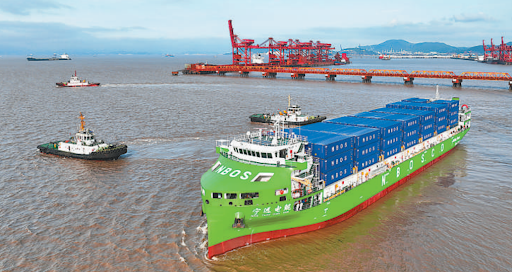
The world’s largest pure electric intelligent container vessel, the Ning Yuan Dian Kun, developed by China, embarked on its maiden voyage on April 15, marking a new step in the country’s push toward greener and more intelligent coastal shipping.
At 4 p.m., the ship departed from Ningbo-Zhoushan Port in east China’s Zhejiang province, heading for Zhapu Port in Jiaxing, Zhejiang province, a journey of about 70 nautical miles.
With its bright green hull cutting across the deep blue sea, the vessel stood out at first glance. Along its side, the words “Battery Power Zero Emission” highlighted its defining feature — fully electric propulsion with zero emissions during operation.
Developed by Ningbo Ocean Shipping Co., Ltd., the Ning Yuan Dian Kun is recognized as the world’s largest vessel of its kind and China’s first 10,000-ton-class pure electric intelligent container ship. Its launch into commercial service signaled a new phase for China’s coastal container transport, combining clean energy with intelligent navigation.
What sets this vessel apart?
Onboard, an integrated smart navigation platform displays real-time data across multiple digital screens. Positioned at the stern, ten standardized container-sized lithium iron phosphate battery units — the ship’s primary power source — are neatly arranged, . With a total storage capacity of around 20,000 kWh, the system is equivalent to the combined battery capacity of about 300 electric cars.
The environmental benefits are substantial. Once fully operational, the vessel is expected to save around 580 tons of fuel annually and cut carbon dioxide emissions by more than 1,400 tons, roughly equal to the yearly carbon absorption of 40,000 mature trees, achieving truly zero-emission, zero-pollution voyages, said Wang Ting, captain of the vessel.
“The most noticeable difference compared with conventional fuel-powered ships is the profound quietness,” Wang said. “The engine room was once dominated by the roar of the main engine, but now we sail almost silently, which significantly improves crew focus.”
He added that electric propulsion also delivers smoother and more responsive acceleration and deceleration, with minimal delay. However, he emphasized, “This requires careful energy management — operators must monitor battery consumption closely and adjust speed planning accordingly.”
Compared with vessels powered by liquefied natural gas (LNG), pure electric ships rely more heavily on charging infrastructure, especially for longer routes. The steady expansion of shore power facilities has already made electric vessels more common along inland waterways like the Yangtze River.
But is an all-electric vessel capable of handling sea routes?
“The vessel’s range fully meets the requirements of this specific route, incorporating a built-in safety margin,” said Chen Xiaofeng, chairman of Ningbo Ocean Shipping Co., Ltd. Behind this capability lies a comprehensive system integrating battery capacity, energy management, and charging solutions.
From a design perspective, the biggest challenge was not a single technical hurdle, but integrating an entire electric propulsion system into a 10,000-ton-class seagoing vessel.
“Stable power supply under complex maritime conditions places high demands on energy management and system safety,” Chen explained. To address this, the company worked with partners including the Shanghai Merchant Ship Design and Research Institute and China Classification Society to overcome key technical challenges, optimizing battery layout and improving energy efficiency.
Equally important is the charging system. The vessel adopts a dual approach combining shore-based charging and battery swapping. In current operations, shore power charging has proven sufficient, while the battery-swapping model is being further developed as a reserve solution.
To support the vessel’s battery-powered and autonomous navigation systems, maritime authorities in Ningbo introduced dedicated service and safety protocols, completing real-world tests for functions such as intelligent route tracking and dynamic collision avoidance in advance. The ship’s smooth operation and rapid decision-making response have demonstrated the reliability and stability of its smart navigation system in real-world conditions.
The maiden voyage of the Ning Yuan Dian Kun also underscored the broader potential of green shipping.
While all-electric vessels require higher upfront investment, they offer significantly lower energy and maintenance costs over time, particularly on short, high-frequency routes where their economic advantages are more pronounced.
“Green shipping brings both immediate and long-term benefits,” Chen said. “In the short term, it reduces fuel consumption and emissions. In the long run, it enhances market competitiveness.”
As global clients place increasing emphasis on supply chain carbon footprints, low-emission shipping capacity is becoming not just a competitive edge, but a shared direction for the industry’s future.
In recent years, China has seen rapid growth in new-energy and clean-energy vessels. From inland waterways to ocean routes, the share of green ships continues to rise steadily.
Statistics show that by the end of 2025, China had over 1,600 clean-energy vessels operating on coastal and inland waterways, including battery-powered, LNG, methanol and hydrogen fuel cell ships. China boasts one of the world’s largest clean shipping fleets and takes a global lead in the application of electric watercraft.